Showing posts with label MAD Magazine. Show all posts

Thursday, December 21, 2017

A Cool MAD Moment


Like most dads, I want my sons to think I’m cool. And like most dads, my sons think I’m about as cool as a convection oven. When I try to act cool in their presence, they mostly think I’m goofy and embarrassing. But I’ve never minded this, because I have always had an ace up my sleeve that I was waiting to play. Finally, after eleven years of fatherhood, I was able to play that ace.

From age 20 to 25, I worked on the editorial staff at MAD Magazine, and for about fifteen years after that, I continued to write for them on a freelance basis. (To read a previous blog entry about the incredibly true tales of my time at MAD, click this link here: this link here.) Very few people are impressed by this information—nor do I try to use it to impress folks—but the majority of those who are impressed are the ones who read the magazine faithfully many years ago and have fond memories of secretly flipping through its pages under their bed covers when they were supposed to be asleep. These folks usually ask me if I ever met Al Jaffee (yes) or Don Martin (no) and wax nostalgic about the magazine.

But every once in a while I have had occasion to meet a preteen who is an active reader of the magazine. These are generally children of friends who I meet at a social gathering. The parent usually introduces me to their child with this line: “This is my friend, Andrew. He used to write for MAD Magazine.” The kid inevitably reacts like they were just introduced to a rock star—their jaw drops, they swoon, and they get tongue-tied. The parent then bales them out and tells them to go play in their room. These brief episodes, awkward as they are, inevitably give me an ego boost. Being reacted to like you’re a rock star (even when you’re the furthest thing from one) tends to do that.

My association with MAD is something that I have never gone out of my way to mention to my own kids. It is not exactly something that they would have cared about when they were younger, and with all of the MAD books and magazines on our shelves, I figured they would eventually discover this information on their own, anyway. Secretly, I looked forward to the day that my kids would look at me the same way that my friends’ kids did, and for a brief moment they might think, “Holy cow, dad is a rock star!”

About a month ago, my long range plan finally came to fruition.

My sons, who are now 11 and 8, are both voracious readers. Chapter books, graphic novels, young adult fiction, and the occasional non-fiction books on topics of interest are all in their wheelhouse. The challenge is, our house can only fit so many books. They have hundreds of paperbacks on their shelves and are often in possession of library books, but even so, there are times when they have simply run out of reading material and start wandering around the house looking for new words to read. On one such occasion my 11-year-old found himself looking up at a high shelf on our bookcase in the den that was loaded with MAD paperbacks.

“Could I read one of those?” he asked, pointing to the MADs.

“Hmmm. I guess so,” I said, looking at the titles.

I wondered how to start him off on this journey. The books he was pointing to were mostly from the 60s and 70s and I knew that the vast majority of references, to things like Watergate and flower power, would go completely over his head. I saw a “Snappy Answers to Stupid Questions” book and figured those gags were pretty timeless. I pulled it off the shelf and handed it to him. Back he went to his room.

A couple of hours later he came out and asked if he could have another one.

“Did you like it?” I asked.

“Yeah, it was pretty funny,” he said; so I grabbed another off the shelf and away he went.

In short order my older son was devouring the MAD paperbacks and sharing them with his younger brother. Soon, they had gone through all of the paperbacks (Nixon references and all) and asked about the magazines. Again, I decided to be strategic about how to start them out.

For a short period of time (2005 – 2009) MAD produced another magazine called MAD Kids, which was geared toward a slightly younger audience. I figured that showing them those magazines first would be a good way to segue them into the parent publication. I gave them each an issue of the mag and sent them on their way. They read them. They exchanged them. They enjoyed them.

What they didn’t know about the magazines I had handed them was that they each contained an article I had written. I was waiting to see if either of them would stumble across this fact on their own, but alas, they never seemed to pay attention to the bylines. Apparently I would have to nudge them in the right direction.

I sat myself down near my younger son as he read one of the magazines. After a few minutes he got to the article I had written in that issue. He read through it (sadly, with no particular reaction) and was about to turn the page when I asked, “Did you notice who wrote that article?”

He started looking around for the byline (they put it in really tiny print) and eventually said, “Bob Staake.”

“Well, that’s the artist,” I said. “The writer’s name is next to it.”

My son looked at the name next to it and his eyes practically bulged out of his head. He looked up at me with a gigantic grin plastered on his face, then looked back down at the mag and proceeded to reread the article—this time laughing at all the gags. When his older brother walked into the room moments later he ran over to him and said, “Look, look! Dad wrote this!” pointing frantically to the byline.

My older son looked quizzically at the magazine for a moment before he could focus on what his little brother was showing him. Once he focused on the byline his reaction was almost identical to that of his brother’s—eyes bulging, grin taking over his face and a quick double take, as he looked from the magazine, to me, and back at the magazine. He also reread the article, but then went on to something else.

And that was pretty much it. There was no extended adulation, no makeshift parades and no asking for my autograph. But what there was, were a few moments when both my sons thought I was cool. Fleeting, yes—but worth the eleven year wait.


Wednesday, July 27, 2016

Goodbye, Jack Davis

Growing up a rabid MAD magazine fan in the 1970s and 80s there were several artists whose work I revered above all others. Men like Al Jaffee, Mort Drucker, George Woodbridge, and Paul Coker were living legends in my eyes. But perhaps the most legendary to me was Jack Davis, who was equally adept at pinpoint caricatures as he was at goofy cartoons. His illustrations seemed to come alive on the page. 

And I seemed to see his work everywhere—not just in MAD. I would spot his work on the front of TV Guide and Time, and on movie posters like the one for "Animal House." Every time I saw his distinctive work on some non-MAD thing I would get excited. It was like a life bonus to see Jack’s work somewhere besides MAD.

When I went to work as an intern at MAD in the summer of 1990 I got to meet a lot of the living legends like Al Jaffee and George Woodbridge, who lived close enough to the editorial office that they would drop off their work in person. But many contributors lived too far for frequent visits and they would send their work via UPS or FedEx. Jack Davis, sadly, fell into this category, as he lived in Georgia, so as a MAD intern I had to settle for hearing his endearing southern drawl on speaker phone from time to time.

Toward the end of my internship I sold my first freelance article to MAD. It was a spoof of the television show “Unsolved Mysteries.” As excited as I was to make the sale, I was even more excited when I was told by the editors they had decided to have Jack Davis illustrate. Actually, excited doesn’t properly capture my reaction—it was more a combination of dumbstruck and delirious. That an artist I idolized from the time I was a small boy would be drawing pictures based on words that I wrote was beyond surreal. And once I saw the actual article in print with our bylines next to each other, I was giddy for a week.
From MAD #304, July 1991
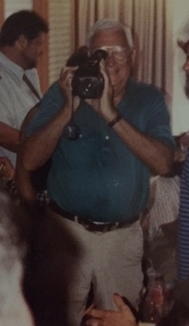
Eventually I did get to meet Jack Davis, who was like a lovable grandpa with an unexpected mischievous streak. It was a little over a year after my internship. I was now working for MAD fulltime and I got to go on the biennial MAD trip. It was a cruise to Bermuda and Jack was there with his wife, Dena. I was awestruck in his presence—not only because of his incredible talent, but also because he towered over me by about a foot. Meeting him was definitely one of the highlights of my MAD career.
Jack Davis Videotaping me Taking a Picture of Him

Interestingly, I would go on to sell about 50 articles to MAD over the next decade-and-a-half, but that first one was the only one Jack illustrated. I was definitely fortunate to have had that opportunity.

When I found out today that Jack passed away at the age of 91, I was saddened, wistful, nostalgic. Jack was an amazing artist and a gracious guy. That I got to have any sort of association with him is an incredible honor. He will be missed.


Sunday, July 19, 2015

Twenty Years in Arizona

Twenty years ago this month I became a resident of Arizona. I landed at a Motel 6 in Tempe, before moving into a one-bedroom, furnished apartment in Mesa, whose monthly rent was a little less than half that of the tiny studio apartment in which I had been living in Manhattan’s Upper East Side for the previous three years. I was excited to be in Arizona after a seven-week road trip that took me through 17 different states. (I realize you can get from New York to Arizona in three or four days, but I decided to take the scenic route.) And 20 years later I’m still excited to be here.

Certainly, I can write a small book about my time in Arizona, but since I don’t have an agent, publicist, or crazy, stalker fan, I’ll just focus on a few highlights of my time in Arizona so I can keep it to regular blog size. Let’s go sequentially, shall we?

The Really Early Days

After seven weeks of living on the road at campsites, youth hostels, and the back seat of my Oldsmobile Delta 88, I finally settled into my small, neat apartment overlooking a swimming pool. And after the initial excitement of getting to my destination wore off, I was bored out of my mind. After almost two months of hiking (summited Harney Peak, highest point in South Dakota), sight-seeing (went to the football Hall of Fame in Canton, Ohio), and partying (got drunk at the Steamboat Days festival in Burlington, Iowa) I suddenly had nothing much to do. Mostly I spent my time watching Court TV, because the O.J. Simpson trial was in full force and, well, it was better than watching daytime soaps. I also wrote a lot—freelance articles for MAD, a screenplay I never did anything with, and journal entries about…the O.J. Simpson trial.

After a few months living off my savings and an occasional MAD sale, I thought I should probably get a part-time job to have at least some sort of steady income. I drove up the block, stopped at the first “Help Wanted” sign I saw, walked in, told the boss I used to work at MAD Magazine, and was hired on the spot. I was now a short order chef at a hamburger joint called The Longbun Grill. As a vegetarian this was, admittedly, an odd career move, but I needed some cash and the place was a 90-second drive from my apartment, so it worked out well. Whenever the boss asked me if I wanted to try the burgers or the bratwurst we made, I told him I was allergic to meat. Somehow he believed me. I worked at The Longbun Grill for about five months and then my freelance income picked up enough that I was able to quit.

The Theater Days

Supporting oneself as a freelance writer may sound romantic, but it can be a lonely lifestyle. I spent the bulk of my days writing and/or staring at walls trying to come up with something to write about. I spent the bulk of my evenings watching sitcoms and/or trolling in AOL chatrooms. I didn’t have much in the way of in-person social interactions, other than the once per month I went to the office of my apartment complex to pay my rent. Yes, it was fairly pathetic.

Eventually it occurred to me that I should participate in an activity I enjoyed that afforded the opportunity to interact with other humans on an ongoing basis. I enjoyed reading, but it turns out that trying to chat someone up who’s reading in a library generally does not go over very well. I enjoyed watching movies, but it turns out that trying to chat someone up in a movie theater goes over even worse. Finally, I hit upon something—acting. I’d done it for years in school, but never in my adult life. As it turned out there was a community theater a couple of miles from my apartment and they were having auditions for a play called Night Watch. I auditioned and got cast as a New York City police lieutenant. I’m sure my accent—mild by New York standards, but thick as a calzone by Mesa, Arizona standards—is what got me the part.

Acting again, after about a seven year hiatus, was exhilarating. Even more exhilarating, however, was that I suddenly had a social life again, after about a seven month hiatus. Hanging out with my cast mates on a regular basis was a blast. We often went out as a group after rehearsals and performances and, because of the close proximity of my apartment to the theater, we had a cast party at my house on the final night of the show. (I could tell the party was a success, because when I came back from a beer run I found out the cops had been to my apartment while I was gone to tell us to turn down the music.)

Over the next four years I became ensconced in the local community theater scene. I bounced from show to show, theater to theater, playing a variety of roles both big and small. I found many a kindred spirit in the Arizona theater world and made many a lifelong friend along the way. After doing about a dozen shows I decided to try something a bit different and joined an improv group called Comedy Sportz Phoenix. I found improv even more exhilarating than traditional theater, due to the fact that it was all unscripted so the next line in the show was anybody’s guess. This was both exciting and terror-inducing, and I loved it. I found even more kindred spirits in this setting, but more importantly, it was during this timeframe that I also found the woman who would become my wife.

The Romance Days

Nicole does not perform improv (at least not on a stage in front of other people) but she sure does enjoy watching it. We met as coworkers at the University of Phoenix (I was temping there to supplement my sporadic freelance writing income) and became great friends. She soon found out that I was part of an improv comedy troupe and came out to see one of our shows. She laughed at every joke…and loudly…and contagiously, so that there were no dead spots throughout the entire show. Everybody in the troupe loved her, because she was like our own personal laugh track.

After that first show she came to another, and another, and another. Eventually I started wondering if she was coming because she liked to laugh or because she liked me. Then I realized the truth was probably somewhere in between—she was coming because she like to laugh at me! Finding a beautiful, intelligent woman who laughed at everything I said was my dream come true, and soon we started dating. Five months later we were engaged and seven months after that we were married, less than a year after we started dating. (I realized once I found somebody who laughed at my good and bad jokes equally, I had to seal the deal quickly.)

For the next six years after we got married we ate out a lot, went to lots of movies, entertained often, traveled frequently, and generally had a great time. Then we had kids.

The Family Days

Okay, okay. I know the last sentence of the previous section sounds bad. I don’t mean to say we haven’t had fun since having kids—certainly we have a ton of fun. Of course, we don’t eat out, go to the movies, entertain, or travel anywhere near as often, but we sure do play with Legos—lots and lots and lots of Legos.


And we sometimes go to the city pool. When I grew up in New York, summer break was a time to play outside with friends, but here in Chandler, Arizona, where the average temperature in July is 105-degrees, playing outside is the last thing you want to do, unless you have a pool, which we don’t. So we often go to one of the City of Chandler pools—most often one called Desert Oasis. It’s really a lovely pool—as long as you’re not grossed out by the thought of what the toddlers running rampant in the pool might be evacuating into the water.

And that, my friends, is a very, very high-level synopsis of my last 20 years in Arizona. I feel remiss having skipped stories about karaoke singing, scorpion hunting, and searching for (and finding) decent pizza, but you’ll have to wait for my book to find out about those things. But first I have to find an agent, a publicist, and a crazy, stalker fan. Oh wait, I already have one of those—and I married her! I’m one-third of the way there!

Thursday, June 4, 2015

My 25th MADiversary: A Memoir of Idiocy

Me posing with MAD paraphernalia at the 1994 MAD holiday party

June 4, 1990 was a defining moment in my life. On that Monday, exactly 25 years ago today, I traveled from Brooklyn to 485 MADison Avenue (midtown Manhattan), took an elevator up to the thirteenth floor, and stepped into the offices of MAD Magazine as a summer intern. I would be getting paid $150 per week, but would have gladly paid that amount myself for the privilege of working in the hallowed halls of the humor magazine that I revered from the time I was a small, wide-eyed child. Now, as a small, wide-eyed college student, I could barely contain my excitement as I sat down in the dingy office that would be my home for the next six weeks and sifted through a box of fan mail while I waited for the editors to arrive.

While this was my first time at MAD in an official capacity, it was not the first time I had set foot in their offices. A couple of months earlier I had gotten the phone call (which increased my heartrate by a magnitude of several thousand) from then Associate Editor, now Senior Editor, Charlie Kadau, letting me know that I was chosen as one of the magazine’s two summer interns. Charlie asked me if I wanted the June to July slot or July to August slot, and I spat out some incoherent babble that he correctly took to mean I wanted the first slot. He then invited me to stop by the offices sometime in May to meet everyone and see where I’d be working. So it was, a couple of weeks before my official start date, I went to the MAD offices to meet the Usual Gang of Idiots. I was never more nervous about anything up until that point in my life.

You have to understand that my personal connection to MAD ran long and deep. I was born in 1969 and I have brothers who are eleven years and seven years older than me, so they were prime MAD-reader age at the height of the magazine’s popularity, just as I was being potty trained. And if ever there was a magazine that was appropriate to look at while peeing in your pants, MAD was the one. But it was not only my brothers who indoctrinated me into the ways of MAD. During my grade school years I came to learn that my cousin David had one of the most impressive collections of MADs east of the Mississippi. Every time we went to my cousin’s house I would spend hours poring over old issues of the magazine from the 50s and 60s. By the time I reached junior high I could tell you the name of every writer and artist and could recite the masthead verbatim, the way a cultured person might be able to recite a Shakespearian sonnet. I idolized the MAD men, but none held a loftier place in my mind’s eye than William M. Gaines, founder, publisher, lord of the idiots!

So, on that day in May, when I was given the MAD tour by the other then Associate Editor, now Senior Editor, Joe Raiola, and the very first stop on the tour was the office of William M. Gaines (who I was told to call Bill) I was shaking so hard that I’m sure Bill and his wife Annie must have thought that I had some sort of medical condition. They were both quite gracious and welcoming toward me, despite the fact that I couldn’t get a coherent word out. As we left Bill’s office, Joe looked at me as one might look at someone muttering to themselves on the subway, and gently said, “It’s okay. Calm down, man.” I did calm down—in part because of Joe’s soothing tones, but mostly because now that I’d met Bill I knew that nothing else would be as daunting.

Bill and Annie Gaines in Bill’s office at 485 MADison Avenue

I don’t remember who else I met during that first visit, because in my faded memory, the rest blends in with the internship itself, but over the course of the next two months I did get to meet many of my childhood idols. Al Jaffee, Dick DeBartolo, Angelo Torres, George Woodbridge, Paul Peter Porges, and Stan Hart were all regular visitors to the office. One of the things that surprised me most when I started working at MAD, was that all of the writers and artists were freelancers, meaning none of them worked in the actual office. They only stopped by from time to time to drop off their work or tell dirty jokes. The creative staff at that time only consisted of seven people—five in the editorial department and two in the art department. And then there was me—thrown into the mix for six weeks, constantly doubting my comic worthiness as the rest of the staff threw pointed barbs around at 100 miles per hour.

Although I doubted myself, I was having a blast reviewing writers’ submissions, looking at artist’s rough sketches, and watching the constant comedy show provided by my coworkers. I shared a small office with Charlie Kadau, Joe Raiola, and the third Associate Editor, Sara Friedman; but a large portion of my time was spent in the office of then Editor, now Senior VP and Executive Editor, John Ficarra, whose office is pictured below. John is the one seated, while Charlie is the one holding the Easter Island head.

Charlie Kadau and John Ficarra, sometime in the early 1990s

Take careful note of the snare drum next to John’s desk. That was there so he could do rim shots whenever someone delivered a particularly effective zinger. Every Wednesday we would gather in John’s office for editorial meetings and I would long for the moment when I might say something to earn a rim shot. My moment finally came one day when we were coming up with department titles for the articles in issue number 299. For the uninitiated, department titles are puns used on the table of contents page on top of each article. For example, the standard department title for Spy vs. Spy is “Joke and Dagger Department.”  The department titles for ongoing features were set in stone, but new articles needed new department titles, so we sat around the office throwing out puns. We were trying to come up with a department title for an article written by Mike Snider and illustrated by John Pound called “World Communism Close-Out Sale,” and I spat out, “What about ‘Attention K. Marx Shoppers?’” Instantly the rim shot came and Nick Meglin, a 30-year plus MAD staffer who shared the editor title with John, turned to me with a broad smile and said, “Whoa! Good one, Eel!”

Masthead showing my summer internship with the department title that earned me my first rim shot below. (Note: While my internship was in June and July, the magazine had a six month lead time, which is why the date of the issue is December 1990.)

I should probably pause here for a moment to explain why Nick Meglin called me Eel. I’m a small guy and generally a quiet one, so my comings and goings can sometimes go unnoticed. One day I stepped into John’s office while Nick and several other staff members were there. Nick didn’t hear me come in and I guess I was standing in his blind spot, because when he turned and saw me right next to him he got startled and shouted, “When did you get here? You slithered in like a f***ing eel!” The staff roared with laughter, one thing lead to another, and suddenly John coined me “The Brooklyn Eel.” I wasn’t thrilled with the nickname at first, but somehow it stuck, and soon almost everyone on the staff and all the freelancers were calling me The Brooklyn Eel, which mostly got shortened to Eel. (A few years later when I moved to Manhattan’s Upper Eastside, my moniker was changed to The Eastside Eel.)

Another highlight of my time as an intern was being asked to appear on the magazine’s back cover. While the majority of the magazine’s articles are illustrated, every once in a while an article calls for a photo shoot. In an instant I went from editorial intern to male model. Clearly, the magazine does not have high standards.

Back cover of MAD #301, March 1991

When my internship ended I was thoroughly depressed. While I was new to the work world, I recognized that rarely does one find a job where they get paid to sit around and make wisecracks all day long. Indeed, what I had gotten paid to do for the previous six weeks would get 99.9% of people fired. But my depression was tempered by a flicker of optimism. During my internship I was encouraged to submit article ideas, and at the time that I left, one was on the verge of becoming my first freelance sale. I had always dreamed of becoming a professional writer and had submitted dozens of short stories (mostly humorous sci-fi and horror tales) to magazines from the time I was 15 years old, without any luck. But in the fall of 1990 my lifetime drought finally ended when I was handed a $1,200 check for my satire of the television show “Unsolved Mysteries.” My spoof was called “Unsolved Miseries.” Genius, I know.

But even though the check was larger than any I had ever been handed to that point in my young life, the thing I was even more excited about was that my article was going to be illustrated by Jack Davis, whose work had been appearing in MAD since the very first issue in October 1952. I had admired Jack’s work since my diaper days and now his art was going to be paired with my words. The wow factor for me was probably heightened by the fact that I had still not met Jack in person, as he lived in Atlanta and would send his work via FedEx. I had heard his stately southern drawl on speaker phone in John’s office, but because I had never met him face to face, there remained a mythic quality about him in my mind. It was like my article was being illustrated by Zeus.

First page of my first MAD article – Issue #304, July 1991

Once I made my first MAD sale I was hooked. I began spending a large portion of my spare time trying to come up with article ideas. Many of my ideas were rejected, but having been on the editorial side of the fence this didn’t faze me, because I knew that most ideas that writers sent in did not end up making it to the pages of the magazine. Sometimes an idea wouldn’t be outright rejected, but the editors would ask me to try it from a different angle. I would craft, I would hone. I would still usually be rejected, but every once in a while I would make a sale.

While all of this was going on in the beginning of my senior of college, I started contemplating what I might do once I graduated. I was at a loss. The skills I learned at MAD were really not transferable to any other office on the planet and there seemed no hope of getting a permanent job at MAD given the very small staff size. The freelance checks, while large in my eyes, were few and far between, so I knew that supporting myself that way was not realistic. I started buying lots of lottery tickets. That was much more realistic.

Then, in September 1991, something amazing and wholly unexpected happened. The editors asked me if I’d like to work at the offices part-time on a contract basis, two days per week. I’m pretty sure Guinness doesn’t have a world record for the amount of time it takes to say “yes” once a question has been posed, but I’m relatively certain if such a record existed I broke it at that moment. Two months after my internship ended, I was now an Editorial Assistant. This part-time, contract gig came with no promise that it would evolve into a full-time staff position and yet somehow, miraculously, it did.

A couple of months before my graduation, Sara Friedman let the editors know that she would be moving to Russia to be with her husband who was an Associated Press reporter there. Suddenly, a full-time position was available and Nick and John, perhaps too lazy to look for a more qualified candidate, offered the slot to me. My fancy degree in English Literature from NYU was going to be put to good use.

The timing of my coming to work full-time at MAD in June 1991 could not have been better. Every two years Bill Gaines took the entire staff, all of the regular freelance contributors, and all of their significant others on an all-expense paid trip. The next trip was coming up in September 1991 and I was suddenly on the list to go on a cruise to Bermuda. What, me excited?

Describing the Bermuda trip could be a tome unto itself, so I’m not going to go into intricate detail here. Instead, I’ll just share a few photos with captions…

Bill Gaines was a huge Marx Brothers fan, so someone got it in their mind that as a gag we should reenact the famous stateroom scene from “A Night at the Opera,” where tons of people show up and crowd into the small cabin. Bill had no idea this was coming, but one by one people started barging into his cabin uninvited much to his surprise and amusement.  I’m pictured above in the middle wearing a teal shirt and staring down at the ground. Directly behind me on my left is John Caldwell and to his left is Bob Clarke and to his left is Annie Gaines. Holding a tennis racket in the front of the frame is Angelo Torres and right behind him with a camera held high is Dick DeBartolo. Way in the back of the pic with the dark hair and beard is Sam Viviano. I don’t know the guy behind me on my right side. He worked on the ship, as did many who were roped in to help us with this gag.


One night on the cruise there was a masquerade ball, but nobody knew to bring costumes. I was bummed because I wanted to participate, when suddenly I had an epiphany. I was on a cruise ship with a dozen of the most talented cartoonists in the world—surely one of them could make me an impromptu gorilla mask. I asked John Caldwell and he happily obliged. Soon after the cruise was over I asked Caldwell if he would sign the mask. If the inscription in the corner is too small for you to read it says, “Eel, we’ll always have Bermuda! Love, John Caldwell ’91.” This pic hangs in my den to this day.

This is a group photo of everyone who attended the Bermuda cruise. In the words of Mike Snider who sent me this photo, “You’re on the far left, either doing your best Mr. Dapper Dude pose, or being John Ficarra’s ventriloquist dummy.” Famous MAD folks in this photo who I have yet to mention at any point in this article include Sergio Aragones, Duck Edwing, and Paul Coker. I’ll let you Google them to figure out who’s who.

While the MAD cruise was a definite highlight of my first year at MAD, the truth is I was having fun at work on a daily basis. It was like I was a cast member of an R-rated Romper Room.  Of course we had to work—there was a magazine to put out every six weeks after all, and the final week of production was often pressure-filled—but we had no discernible dress code, had a Star Wars pinball machine in our storage annex that we could play whenever we were bored, and sat around most of the time talking about and making fun of pop culture, which was of course, our jobs. It was a fine time, but the party came to a screeching halt on June 3, 1992, when Bill Gaines, our beloved, eccentric leader passed away at the age of 70.

Bill was a crazed visionary and a patriarchal figure to the staff and contributors of MAD. It often felt like he and Annie were the parents of a bunch of out of control adolescents, and I was honored to be one of the brood. When he passed away it hit me almost as hard as when my own dad died six years earlier. In the days following Bill’s death I often found myself wandering around our office suite aimlessly and/or just staring into space. It felt like I was suddenly a crewman on a rudderless ship.

But of course, the show went on. Difficult thought it was, we continued to produce the highest quality low-quality rag in America, with John and Nick leading the way. Yes, the idiocy continued as Bill would have wanted it and soon I was asked to model again—this time for the front cover. As a result, I have the unique distinction of being the only person in the history of the world whose photograph has appeared on both the front and back covers of MAD Magazine. Of course, as you’ll notice below, you don’t actually see my face on the cover, but that is, indeed, my body and arms.

Andrew J. Schwartzberg—magazine cover boy…with an Alfred E. Neuman jack-o-lantern superimposed on his head

This was a very odd photo shoot, to say the least. Irving Schild, MAD’s go-to photographer, had me come to his studio at midnight (presumably he didn’t want anyone seeing the questionable quality of talent he had to work with) and we were there until somewhere around 4:00 A.M. There were two possible concepts for this cover—one is the one you see above, and the other was me holding a mirror in my left hand instead of pumpkin rinds. Below is one of hundreds of Polaroid proof shots from the concept that was not used.

Andrew J. Schwartzberg looking like a psychotic killer for the sake of art

Irving took countless pictures of me holding that knife and mirror at slightly different angles and wearing different styles of shirts. After a couple of hours of pictures with the mirror we moved on to pictures with the pumpkin rinds. But first we had to create a mess. Irving had purchased a bunch of pumpkins and cantaloupes and the two of us set about bashing them to pieces to produce as much gooey, orange, sticky stuff to put all over me as we could. Irving’s thought behind the cantaloupe was that it would be juicier than the pumpkins and its slop would help to create more of a visible mess. His theory proved to be correct and by the time the photo shoot was finished I felt as though a produce department had spontaneously combusted in my face.

Besides editing, proofreading, pun-creating, and male modeling, another one of my many duties at MAD was giving tours of the offices to fans. Several times a week someone would show up to the offices and ask if they could look around. Generally the low man or woman on the totem pole was stuck with tour duty. This was me until about mid-way through 1993 when I was promoted to Assistant Editor and a new Editorial Assistant—Amy Vozeolas—was hired on. Usually the fans were well received by us, but sometimes they were a bit too overzealous. I don’t remember the exact circumstances behind the photo below, but apparently neither John nor I were particularly ecstatic about having our picture taken at this moment.

John and I not looking particularly ecstatic about having our picture taken at this moment. This fan was nice enough to send me this photo in the mail, probably hoping it would end up on the World Wide Web two decades later.

Although Bill was gone, he and Annie had already put plans for the 1993 MAD trip into motion. This trip, which would be the last MAD trip, was to the Principality of Monaco, the tiny but eminently picturesque mountain country on the border of France and Italy. Somewhere I have photos from that trip that show the amazing scenery, stunning views, and breathtaking landscape of Monaco and the surrounding parts of France and Italy. Somewhere…but I have no idea where. Fortunately, MAD artist, Rick Tulka, was nice enough to send me a few photos from that trip, as you can see below.

John and I not looking particularly ecstatic about having our picture taken by Rick Tulka, while eating lunch in San Remo, Italy


Me and artist, Tom Bunk, on a rainy day in Monaco


A blurry photo of a bunch of us having dinner at a pizzeria in Monaco. I have no idea who’s sitting to my right, but to my left is Paul Peter Porges. The guy waving with the glasses and goatee is Rick Tulka. The person whose head is barely sticking out behind Rick’s waving hand is Mike Snider. The guy in the denim jacket in front of Rick is Desmond Devlin. The woman seated next to Desmond is Joyce Robbins, wife of MAD Production guru, Thomas Nozkowski, who is seated across from Joyce. Between Nozkowski and Porges is Brenda Torney, wife of Rick Tulka. And finally, the bearded man in the lower left hand side of the picture is Lenny Brenner, who was the Art Director at the time. Lenny loved garlic more than any other person I ever met before or since, which is why the art department was often a very quiet place. Oh, and the guy standing up is a waiter whose name I don’t recollect.


Me and a fake sleeping Rick Tulka in the world’s first selfie somewhere in Europe

I consider myself beyond lucky that I got to go on the last two MAD trips. Of course the final trip was bittersweet, because Bill’s absence was keenly felt by all of us. Still, nothing beats traveling internationally with dozens of professional idiots. But the MAD trips were not the only times that the Usual Gang of Idiots assembled en masse.  The annual holiday party was another large gathering of the MAD crew.


Me at the 1994 MAD holiday party with George Woodbridge and Al Jaffee. (My wife thinks I look like a bearded Scott Baio in this picture.)

While the MAD holiday parties were mostly attended by the contributors who lived in the tristate area, every once in a while someone would travel from more far-flung places to attend the party.

John Ficarra pointing to famed MAD artist and writer, Dave Berg, at the 1994 holiday party.

For whatever reason, Dave Berg, legendary creator of “The Lighter Side of…” did not go on the MAD trips. (At least not the MAD trips I went on.) He lived in Marina del Rey, California, so I had never met him in person, although I spoke to him on the phone countless times. So I was ecstatic when “Uncle Dave” as we all called him, decided to come to New York in December 1994 to attend the MAD holiday party. I was thrilled to finally meet him in person and found him to be the perfect combination of lovable and unhinged.

Dave’s “The Lighter Side of…” may have been the most well-known ongoing feature in the magazine, other than Al Jaffee’s fold-in. The feature, which ran from 1961 until Dave’s death in 2002, was basically a series of light-hearted comic strips on everyday life. One of the very cool perks of being on the MAD staff was that Dave often incorporated illustrations of the staffers in his strips. Dave drew me dozens of times while I worked at MAD and I was always jazzed when I saw myself turn up in his work, even though likenesses weren’t his forte and I often looked like some strangely distorted version of myself.


Me and Nick Meglin as depicted by Dave Berg in MAD #336, June 1995

While the gag above is not much of a gag at all, the thing that I found hysterical about it when I first saw it was the preposterous notion that I might be able to beat Nick Meglin in straight sets. Despite the fact that I was in my mid-20s and Nick was in his late 50s at the time this was drawn, Nick was a tennis junky who was in excellent shape and I was just a schlub who bought a racket on a whim. Indeed, the couple of times we played, Nick schooled me good.

Sometime in late 1994 or early 1995 I began experiencing wanderlust. I loved my job at MAD, but I felt like I was done with New York and I wanted to see new places and experience new things. Besides the two MAD trips, I had done a lot of other traveling with friends in the early 90s, so I knew this wasn’t just a desire to travel—this was a desire to live in a completely different place, to test my mettle and see if I could flourish. It was like I decided to thrust myself into my own reality show before reality shows were a thing.

So, in May of 1995 I said goodbye to MAD and New York, bought a car, packed my bags, spent almost two months living on the road, and wound up in Arizona. The picture below was taken in my office at MAD a couple of months before I left.

Me at 485 MADison Avenue in the spring of 1995. Notice the vintage word processor on my desk.

Although my career as a MAD staffer was officially over, my association with the magazine did not end. While I tried to figure out what to do with my life, I needed to somehow make ends meet, so I began freelance writing for the magazine I had just ceased editing for. Suddenly, I was back on the other side of the fence, sending article ideas to my former coworkers. From 1996 to 1999 I sold 26 articles to MAD and managed to make that my primary source of income, but the very sporadic nature of freelance sales began to make me an undesirable combination of paranoid and frugal. (Hmm…not sure there’s actually a desirable combination of those two things.)  Eventually I decided to get fulltime work in an unrelated field and my MAD submissions tapered down to a trickle.

These days, I’ll still send in an idea every once in a very rare while, but it has been a couple of years since I made a sale. But that’s okay, because the truth is that with a fulltime job, volunteer commitments, and two young sons at home, I simply don’t have the time to think in a MAD way anymore…except, of course, for the past six days, while writing this 5,000 word tome. Maybe for my 30th MADiversary I’ll just send myself a card.


Sunday, October 19, 2014

Pieces Of My Past


A couple of weeks after my mom passed away three large boxes arrived at my front door. I had been expecting these boxes—two of them I’d packed myself while I was back in New York and the third was packed by my brother and sister-in-law after I’d left. When my sons saw the large boxes they thought that Chanukah and Christmas had miraculously conspired to arrive three months early, but I knew the truth—these boxes were really time capsules; windows into my former life.

In the days following my mom’s passing I spent a great deal of time cleaning out her apartment with my two brothers. Somehow it seemed her three-bedroom apartment contained six bedrooms worth of stuff. A lot of things got thrown out, a lot of things got boxed up, and a lot of things simply went untouched. Although I never lived in this particular apartment, it was on the same block as the apartment that I occupied from about ages seven through 22 in the Bensonhurst section of Brooklyn. About a year after I moved out on my own, my mom moved two doors down and all the stuff I’d left behind moved with her. Now, two decades and 2,500 miles removed from my childhood haunts, I found myself sifting through the minutia that made me “me.”

After opening up all the boxes, my Chandler, Arizona living room was awash with paraphernalia from Brooklyn, New York. As I surveyed the items before me, I noticed that one section of the living room happened to have a particularly interesting assortment of nostalgia, which prompted me to snap the photo that you see above. Shall we take a walk down memory lane?

The oldest item in the photo is my bronzed baby shoe (circa 1969-1970). You don’t really hear about people bronzing baby shoes anymore—at least it’s not something we ever did with our kids’ shoes. In fact, when I showed the shoe to my boys and told them it was by first baby shoe, they were equal parts amused and perplexed. “How did you get it on?” “It seems like it would be really heavy for a baby to walk around in.” “That’s an ugly color for a shoe.” I had to explain the concept of bronzing to them.  Personally, I think there’s something vaguely creepy about bronzing a shoe. I grew up with the shoe in my room and while I wasn’t actively scared of it, I always looked at it a bit askance. I think in my mind shoe-bronzing is not that far removed from taxidermy, which is not one of my favorite arts.

The next oldest item in the photo is the blue baseball card album. While there are certainly cards within the album that are actually older than my bronzed baby shoe, I was actively collecting cards from about 1980 to 1986. Indeed, the vast majority of my allowance during my junior high and early high school years went to the purchase of baseball cards. The album in this photo is only one of many I used to neatly store the hundreds of 2-1/2” by 3-1/2” pieces of cardboard that I coveted. The very first card in this particular album is a 1978 Don Sutton Topps card. I was curious about how much it might be worth, so I looked it up on eBay and saw that sellers were generally asking anywhere between $1 and $20. I noticed that one seller was asking $154.99. Why the huge difference? Perhaps it was autographed (or maybe even bronzed!), but it just turns out that the seller is insane.

The next item chronologically is my Bar Mitzvah portrait from 1982. While I wasn’t raised in the most religious of families, my Bar Mitzvah was something I’d been looking forward to pretty much my whole life. It was a lavish affair with hundreds of guests all there to celebrate my becoming a man in the eyes of Judaism (although in the eyes of biology it would be almost another year before I technically became a man). The framed portrait of me that you see above is probably the most serious, somber photo of me that exists. This is quite a juxtaposition from the rest of the pictures in my Bar Mitzvah photo album, which includes shots of me dancing like Robert Hayes in Airplane!, lying across the laps of my female guests, and using a fake cigar handed to me by the photographer to strike a Groucho Marx pose. Yes, I remember my Bar Mitzvah fondly.

Moving forward two years to 1984, we have my Lafayette H.S. v-neck sweater. I was given the sweater because I was a member of my high school’s Academic Olympics team. It was the only team I ever belonged to throughout my entire scholastic career, so that sweater was the closest thing I ever had to a uniform. It made me feel like hot stuff. I thought if the school’s jocks could impress girls by scoring touchdowns and hitting homeruns, maybe I could impress girls by saying, “James Joyce” when someone asked, “Who wrote A Portrait of the Artist as a Young Man?” I thought wrong.

The next item in the nostalgia parade is the Dallas Cowboys jacket (circa 1986) at the top of the photo, which I got as a present from my parents on my 17th birthday. While the Cowboys are my favorite football team (and I can finally admit that again this year), the jacket’s real value to me is that it’s the last present my dad got me before he passed away. He actually passed away a little over a month before my birthday, but my mom had told me they had already picked it out together prior to that.  Okay, take a deep breath, wipe your eyes, and let’s move on.

Do you see the gold pouch leaning against the MAD Magazine? (Don’t worry we’ll get to the MAD stuff in a minute.) That gold pouch was a souvenir purchased in Alaska in the summer of 1987. You probably can’t see it, but the writing says “I Struck Gold in Alaska.” Inside the pouch were a few rocks painted gold, to appear like gold nuggets. I went to Alaska with my mom, “Uncle” Murray and “Aunt” Sally. They weren’t actually my uncle and aunt, but they were my parents’ best friends so I often referred to them as such. The trip was a high school graduation gift from my mom. She had told me six months earlier that she would take me anywhere I wanted to go for my graduation. At 17 years old the prospect of traveling with my middle-aged mom and her middle-aged friends was not high on my wish list, so I told her I wanted to go to Alaska, because, although I really did want to go there, I assumed she’d have no interest and the trip wouldn’t actually happen. Well the trip did happen. The majority of the pictures from that trip show me as the quintessential brooding, dissatisfied teen, but the truth is I really did have a good time.

Okay, now to the MAD stuff. As a kid, I was an avid collector of MAD magazines, as were my brothers before me, but the two items here are from my work life at MAD. At some point I’ll write a separate piece about my time as a MAD staffer from 1990 to 1995, but for now I’ll just point out that one of the great perks of working there was all the free magazines and paraphernalia I got. (I gave my kids a couple of Spy vs. Spy pens out of one of the boxes, which they seemed to enjoy even though they were no longer working.) Not sure what year the watch is from, but it’s fun because Alfred E. Neuman is wearing a straightjacket and the hands of the watch go backwards. As for the magazine, it’s from January 1996, which was about six months after I moved to Arizona. My guess is I mailed a copy to my mom, because I had an article in there (“You Know America’s Been Nuked When…”) and I always sent her my published works. (Like how I use the phrase “my published works” as though I’m Ernest Hemingway? The most literary line I had in the aforementioned article was “You know America’s been nuked when the weatherman is drawing little cartoon mushroom clouds on the weather map.” Send me a freaking Pulitzer!)

Well, that’s pretty much it for the nostalgia tour. Although if I start taking pictures of the thousands of old photos I took from my mom’s apartment and blogging about them, the Nostalgia Tour Part 2 might be coming to a blog near you. Stay tuned!

Thursday, April 25, 2013

The Fine Art of Dejunking


I need to start off this essay with a disclaimer: You will NOT be learning the fine art of dejunking by reading this. So if you clicked on this link thinking you would learn how to dejunk like a pro, I apologize for misleading you. Indeed, you would be more likely to learn about particle physics from Paris Hilton than you would to learn about effective dejunking techniques from me.

So why bring this up? Well, yesterday I had one of those moments when you truly see something for the very first time. What I saw was my desk-- and really, I didn't see much of it. The truth is that it is awash in ten years’ worth of detritus. Really, the only visible parts of my desk are the top shelf, where our cat often sleeps, and a 15-inch by 10-inch spot where I place my laptop. The rest of my desk (and it's a decent-sized desk) is overrun by papers, notebooks, magazines, software, index cards, calculators, and the occasional dust bunny.

As I gazed on the monstrosity in my den, I suddenly flashed back about 20 years to my time on the editorial staff of MAD Magazine. At the time that I worked there Nick Meglin was one of the editors. Nick had been working at MAD since the mid-1950s and I'm relatively certain that over the ensuing four decades he never removed one item from his office, which contained six-foot high stacks of paper that were arranged in a way not at all dissimilar to the hedge maze in "The Shining." Of course, given where we worked, the chaos that was Nick's office was often the target of well-crafted mocking and ridicule. I'm sure I threw a zinger or two his way about his office decor during my time on staff. (Although the zingers were often blocked by the gargantuan mass of artwork and 30-year-old contracts that engulfed his workspace.)

And now here I was, looking at my own desk, which was essentially a mini-version of Nick's office. I decided that something must be done and so my dejunking project began. I sat down at my desk and turned my attention to the mess before me. Then I got overwhelmed, so I went into the kitchen and ate a Reese's Klondike Bar. Fortified by the sugar and cocoa rush, I went back to my desk and this time really dug in.

The top layer of junk yielded expected results-- recent bills and receipts that either needed to be paid or thrown out; drawings of Iron Man and flowers from my kids; and random movie ticket stubs. But as I dug deeper I began to surface more unusual items. A map I printed from Mapquest in 2009 to an address in Scottsdale, Arizona that has no meaning to me now. (I'm tempted to drive to it just to see what's there.) Jiffy Lube paperwork for an oil change I got in 2005 for a car I no longer own. (Ironic, since I have no idea where the paperwork is for the oil change I got last month.) A piece of loose-leaf paper on which I scrawled an idea for a children's book about an old codger named "Jimothy." (I didn't write down anything beyond that, so I don't recollect what the idea actually was.) A receipt for a Sonic milkshake purchased in 2003. (Glad I didn't throw that one out!)

While one might think the best method for dejunking my desk might be to simply take a blowtorch to the entire pile, the problem is that tucked in among the thousands of pointless items that I've been saving since the Bush administration (um...yeah...the older Bush) are things that I actually should keep. Instructions on how to change the filter on our humidifier. (Our kids get colds a lot.) The phone number for poison control. (Just in case someone in the house has a run in with a scorpion like my wife did in 2006.) A list of my 500 favorite movies circa 1998. (Hey, I like to see how my tastes evolve over time.)

For each item that one comes across in the dejunking process a choice must be made-- throw out or keep. Throwing out is easy, but what do you do with something that you keep? It can't go back on the pile, because clearly that defeats the purpose. We do have a filing cabinet and some items can go there, but the cabinet is only so large and could not possibly contain everything from the desk. I thought about the garage, but that's a hellish clutter fifty times the size of my desk. (Someday, when I have eight or nine months to spare I'll dejunk the garage.) I contemplated stuffing some papers under my sons' mattresses while they slept, but that doesn't seem like a very fatherly thing to do. So what then? Short of purchasing a larger house I'm at a loss.

And this gets me back to the title of this tome. I know that there are people out there (perhaps even you, dear reader) who are skilled at the fine art of dejunking. I need your help. Maybe you have a pamphlet or a manual that teaches the mysterious ways of this art. If so, please send it my way as I am in desperate need of this vital information. Well, on second thought you better not. It would probably just end up somewhere on my desk not to surface for another ten years.

Maybe just send me a blowtorch instead.